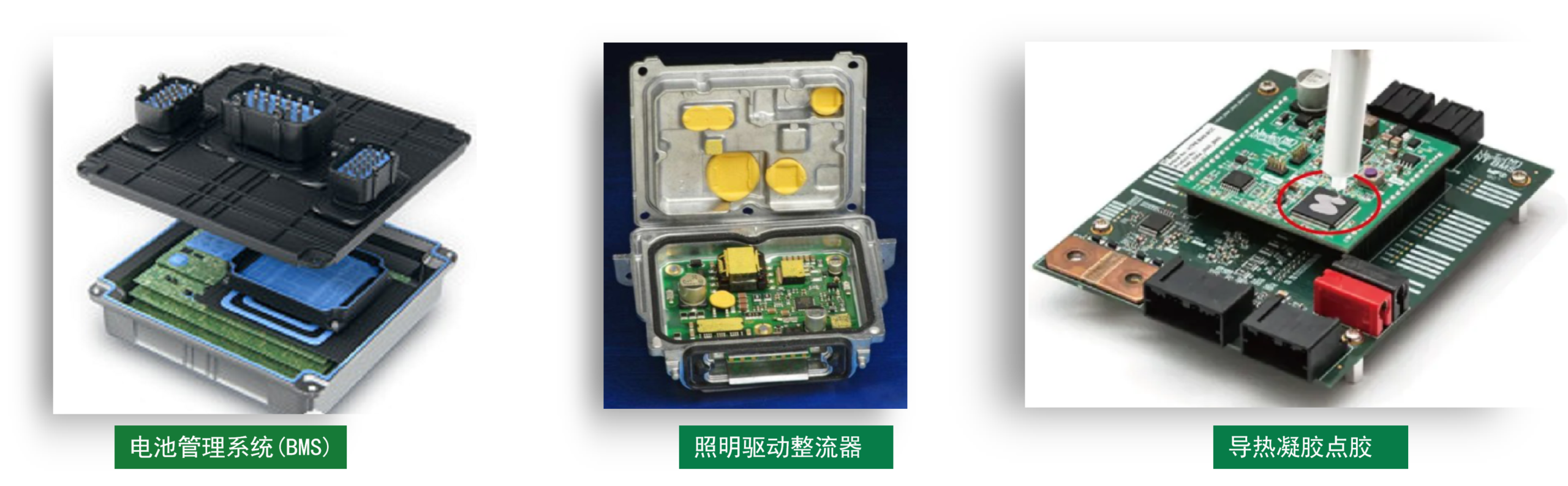
Heat-conducting gel for thermal modules

Used for heat transfer between the battery pack and the water-cooled plate; engine control unit, transmission control unit, fuel pump control unit, the Anti-lock Braking System (ABS), Vehicle Stability Control (VSC), power steering system, lighting drive rectifier, telematics, air conditioning control module, Battery Management System (BMS) and other heat-generating components or modules.

Thermal conductive gel inherits the advantages of silicone materials, such as good compatibility, weather resistance, resistance to high and low temperatures, and excellent insulation properties. At the same time, it is highly malleable, enabling it to fill uneven interfaces and meet heat transfer requirements across a wide range of applications.

Compared with thermal pads, thermal gels are softer and have better surface affinity; they can be compressed to a very low thickness, significantly improving heat transfer efficiency, and can be compressed to as little as 0.1 mm, at which point the thermal resistance ranges from 0.08 °C·in²/W to 0.3 °C·in²/W, matching the performance of some thermal greases. Furthermore, thermal conductive gel has virtually no hardness and does not induce internal stress in equipment after use. Compared to thermal conductive pads, it adheres more easily to the mating surfaces; compared to thermal grease, it provides a better seal and is less prone to powdering.


Related information

Positioning itself in the new energy sector, Bonte’s innovative adhesive materials are driving the industry’s green transition

Against the backdrop of the ‘Dual Carbon’ policy, the new energy industry is entering a period of rapid development, with the pace of technological iteration continuing to accelerate for products such as power batteries, energy storage equipment and new energy support components. As new energy equipment is subjected to working environments characterised by alternating high and low temperatures, high vibration and heavy loads over extended periods, this places extremely high demands on adhesives in terms of bonding strength, resistance to high and low temperatures, insulation and protection, waterproof sealing, flame retardancy and environmental friendliness. High-performance, safe and eco-friendly adhesive materials have thus become a crucial safeguard for the safe development of the new energy industry.


With over twenty years’ experience in the adhesives sector, Bonte leverages its global R&D capabilities to drive high-end manufacturing.

At a time when high-end manufacturing sectors such as microelectronics, displays and new energy are undergoing rapid upgrading, adhesives are no longer merely auxiliary consumables, but rather key core materials that determine a product’s stability, precision and durability. The iterative upgrading of high-end manufacturing is driving adhesive materials to achieve continuous breakthroughs in terms of high precision, high compatibility, environmental friendliness and high stability. Materials companies possessing core R&D capabilities and proven industry experience are becoming vital pillars of the supply chain’s upgrading, with Bonte serving as a prime example.

Empowering Precision Manufacturing: Bonte Adhesives Help the Microelectronics Industry Improve Quality and Efficiency

With the rapid development of 5G, artificial intelligence and the smart device industry, microelectronic devices are continuously evolving towards miniaturisation, high precision, high integration and high reliability. The manufacture of core components such as chips, micro-components and precision circuit boards places the most exacting demands on adhesives in terms of bonding precision, insulation properties, high-temperature resistance and stability; even the slightest deviation in materials can directly affect the performance and service life of end products. Consequently, high-end specialised adhesives have become a critical and essential material for the upgrading of the microelectronics industry.